

 Let me start this post by being up-front about one thing: I haven't always had good things to say about Salvatore's. Some pizza I've gotten there in the past, I wasn't too impressed with. And I'm frankly not a big fan of chain pizzerias generally, although I do try to judge each pizza on its own merits.
But if I am going to try to cover the Rochester pizza scene, I have to recognize that Salvatore's is a major player. Regardless of what I've thought of their pizza over the years, they have been very successful. And they wouldn't be that successful unless a lot of people liked their pizza. So I thought it might be interesting to sit down and talk some time with Sam Fantauzzo, the owner of the Salvatore's chain.
A couple of email messages later, I was able to set up an interview with "Soccer Sam," so named for his love of, and involvement with, local soccer. He proved a gracious and engaging host at his Culver Road "Donuts Delite" location. Sam and I were joined by Nick, who manages that location, Chuck, a "quality control guy" who oversees the entire chain, and Ashley, who's in media relations and who seemed to be Sam's all-around assistant, or what used to be called a girl Friday (which I assume is now a politically incorrect term).
Sam had previously been unaware of The Rochester NY Pizza Blog (what!?!), but after I contacted him, he took a look at it. Not surprisingly, he wasn't entirely pleased with my reviews of Salvatore's pizza. So he clearly wanted to set the record straight about some facts concerning Salvatore's.
And he did. I'm not going to transcribe, verbatim, all of Sam's talking points. Nor am I going to recite the full history of Salvatore's, which is well documented on their website. But I did come away impressed by Sam's dedication to his business and to his pizza.
 Like a lot of other local pizzerias, Salvatore's has its roots in Sicily. Sam got headed down the pizza path in high school, when he chose pizza as a home economics project (he got to take home ec? I was forced to take wood and metal shop, where I had to struggle through making stuff for my mom that she would never use). From there, he found a place on East Main Street that he chose for his first store, and developed a pizza recipe based on his grandmother's homemade pizza.
Sam also learned the ropes of the pizza business from his brother-in-law, who ran Celino's, which at the time was apparently a big player in the Rochester pizza market. (Celino's eventually folded, but I'd like to find out more about them, so if you have any memories of Celino's, please share them in the Comments section.)
That first location was a hit, and as individual employees gained skill and confidence, Salvatore's began to expand. In terms of the pizza, there have been some changes over the years, but they've been relatively minor and incremental. The crust is a bit thinner than it used to be, in line with current customer tastes, but not by much. Salvatore's also now offers a ultra thin crust, but their regular pizza remains medium thick, as that's what the local market wants. Sam considers his pizza to be within the parameters of "Rochester style," which means a relatively thick, airy crust, topped with a generous helping of thick-bodied tomato sauce and mozzarella.
More than once, Sam emphasized that when he started Salvatore's, he wanted to get away from the stereotype of the "sweaty guy in a T-shirt" making your pizza. Sam envisioned a "classier pizzeria": stores would be clean, customers would feel comfortable going there, and they'd know that they could rely on Salvatore's for a consistent, well-made product at a reasonable price. He described Salvatore's at one point as the "Wegmans of pizza," which seems like a reasonably apt analogy.
Consistency is important to Sam, as it is to most chain operations, and to that end, all Salvatore's pizza dough is produced at Palmer's, by Salvatore's employees. From that central location, thousands of pounds a day are sent out to Salvatore's various locations. The recipe is essentially the same as the original, in line with Sam's if-it-ain't-broke-don't-fix-it philosophy; he made a point of telling me, for example, that Salvatore's uses the same brand of whole-milk mozzarella today that they've used from the beginning.
 But though the recipe may not have changed much since the 1970s, that doesn't mean that Sam is sitting idle. He's a regular at trade shows ("I love that stuff," he said) and keeps up with industry trends. Under his direction, Salvatore's has been in the forefront locally of offering delivery (for which he came up with the slogan, "We deliver everything but babies!"), online ordering, and a mobile web site. The "Super Slice," a Salvatore's trademark item, started as an easier alternative to individual small pizzas. And that "Salvatore's! .. dot com" radio ad? Sam's idea, and his voice.
Sam has also expanded Salvatore's offerings, which now extend well beyond pizza, to ribs, chicken, burgers, and plenty more. As he put it, "We're not just in the pizza business, we're in the burger business, chicken wings, ribs," etc. He added that he doesn't consider his competition to come so much from other pizzerias as from other restaurants generally, like McDonalds, Friendlys, and so on. Ultimately, Sam explained, the competition is for the consumer's food dollar. To that end, Salvatore's has added beer and wine to several locations, in an effort to transform it into more of a restaurant as opposed to simply a pizzeria.
A good 80% of Salvatore's business, though, remains "pizza related," and pizza remains Salvatore's core business. While I'm on that subject, I have to say that the pizza we shared was pretty enjoyable. I'm not going to give it a letter grade, under the circumstances, but its medium-thick crust had just a hint of oil underneath - no more than I would expect with a pan-risen and -baked pizza, the crust had a nice "chew," and the toppings were quite good, particularly the huge, meaty chunks of sausage. I had no problem eating my share of the pie.
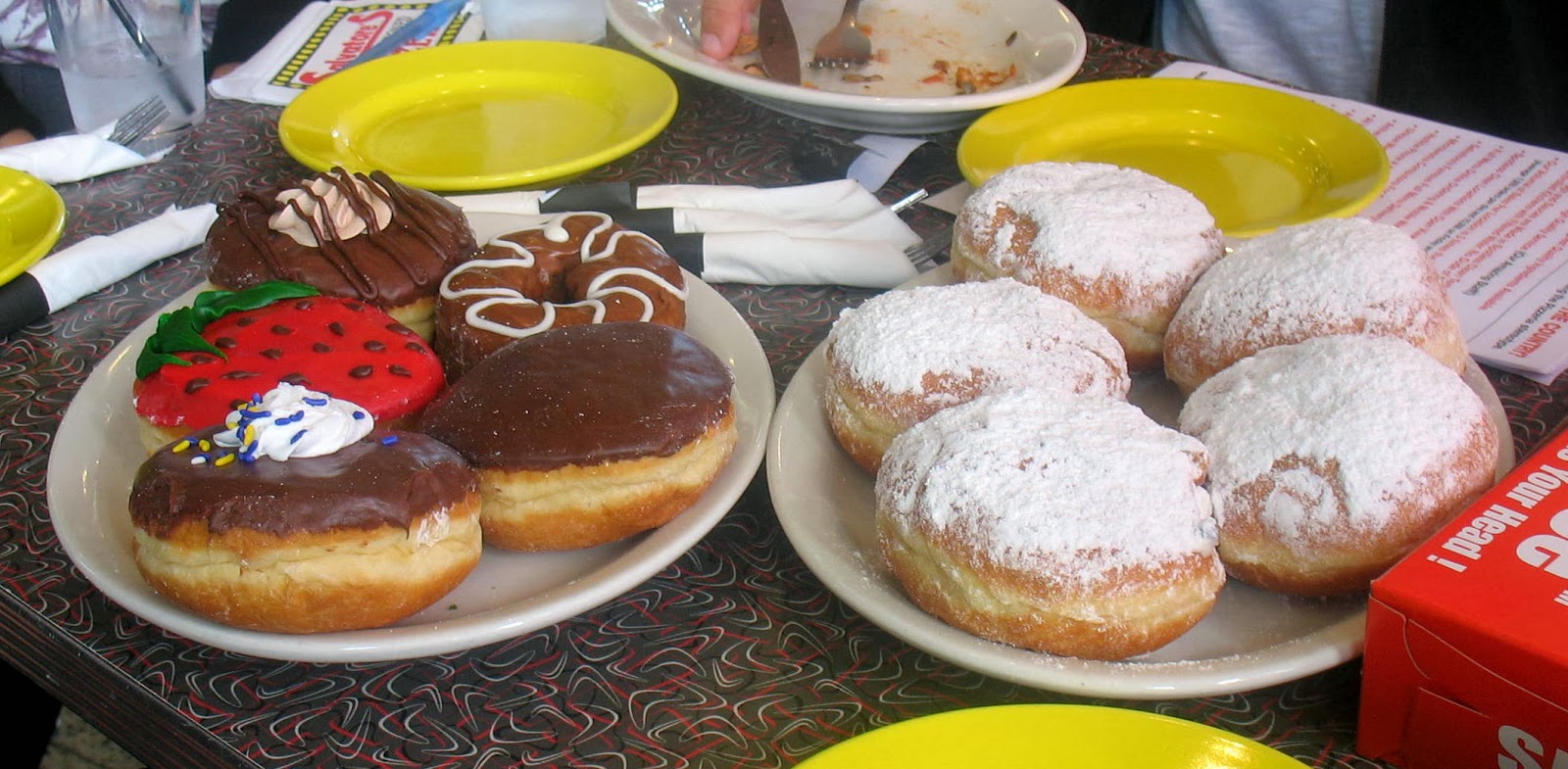
Since we were at the Donuts Delite location, we also talked a bit about doughnuts (somebody, I can't remember who, once wrote that they loved Donuts Delite for misspelling both words in its name, and for whatever reason, that's always stuck with me). In some ways, doughnuts are more of a challenge than pizza, because of the number of steps involved: making the dough, the rise, cutting, frying, and filling, all to turn out a product that sells for about a dollar each. Salvatore's doughnuts are big, visually appealing, and fresh. Sam noted a competing chain's reference to their "baked" doughnuts, which I had wondered about when I saw their ads; in fact, those doughnuts (like nearly all doughnuts that you will find at a retailer) are fried, and only "baked" to reheat them.
 In line with Sam's bent for innovation, Salvatore's also offers cannoli doughnuts, which, as the name implies, are doughnuts stuffed with cannoli filling. They also do "cronuts," a croissant-doughnut hybrid that's one of the latest food trends.
Toward the end of my visit, I got a behind-the-scenes tour of Salvatore's kitchen area, which was spotless and well-organized. I also got an up-close look at Salvatore's air-deck ovens, which Sam mentioned more than once. (He also expressed some disdain for conveyor ovens, saying that they produce "microwave pizza.") The kitchen area was remarkably cool, so the heat from those ovens must be very efficiently dispersed; I guess that goes along with Sam's intent to get away from the "sweaty pizza guy" image.
One technical note: Salvatore's pizzas are baked on trays, which is not uncommon for a pizzeria with heavy volume, like Salvatore's. On a customer's request, they will remove a pizza from the tray and finish baking it directly on the oven deck, once the crust firms up. I'd like to try that sometime, to see what difference it makes in the final product.
As we toured the premises, it was clear to me that Sam is no "undercover boss." Employees recognized him and greeted him. He's clearly a hands-on guy, and among Salvatore's employees, stories circulate about his attention to detail, like the time he tasted the glass cleaner that somebody was using to see if it was the good stuff (it wasn't).
At the same time, I didn't get the sense that Sam is a tyrant, or a control freak in the sense of trying to micromanage each location's operations. He does delegate, and he depends on a reliable team of employees to keep things running smoothly.
But the key word there is "reliable." Sam is quick to admit that he counts on his employees, but they'd better be good, and know what they're doing. Employees who "don't get it" are swiftly shown the door.
After a good hour and half of conversation, I took my leave of Sam, Nick, Chuck and Ashley. I came away with a few impressions. First, Sam is a pretty personable guy. Of course, I don't have to work for him, but I enjoyed talking with him.
He also seems like somebody who's carried on his business the right way. What I mean by that is, he's got some integrity. Early on, Sam developed personal relationships in the pizza business, and he's maintained some loyalty and trust with suppliers and other people he's worked with.
I also got the sense that he's not out to screw anybody, competitors or otherwise. I don't know what his competitors think of Sam, but he expressed admiration for several other pizzeria owners, and he told me that he's refrained from opening up new stores next door to existing pizzerias owned by individuals he considers friends.
Sam is also proud of his accomplishments, and justifiably so, but he is not shy about giving credit to others, especially his employees. More than once Sam expressed his belief that he sees himself and his staff as part of a team. When I asked Sam to name the biggest reason for success, he quickly responded that he's been able to surround himself with "great people who are dedicated and committed."
What also struck me is that, as I mentioned earlier, Sam is not one to rest on his laurels. In response to a question about whether national chains had made things harder for him, he said that in some ways, his business has gotten easier, because it's much easier for him to follow industry trends today. Just look at what the big guys are doing.
And Sam does keep up with trends, avidly. Sam is a sponge for ideas, who's always looking for ways to stay ahead of the game. He didn't use the term "fast casual," but that's one of the hotter trends in the restaurant business these days, and in line with that, several Salvatore's now offer beer and wine, and are transforming into casual restaurants rather than simply fast-food slice joints.
I also think Sam is a dedicated, hard-working owner. He's not just sitting back collecting a paycheck while his underlings do the work. I don't know if I'd call him a workaholic, but this is a guy who by his account starts his day around 3:30 every morning, on about five hours' sleep. Every morning he meets with his staff (at a more reasonable hour, I hope), and he's clearly got a passion for detail.
Although Sam's roots will always be in pizzamaking, he also struck me as, in some ways, more of a business man than a pizza guy as such. At one point, in fact, he said to me, "We're business people, we're not pizza people." I don't think he meant that he's not interested in pizza, but that he recognizes that he's in the pizza business. Sure, he wants Salvatore's pizza to be good, but not just because he loves pizza; he wants his pizza to be good because that's good for his business.
I'm not about to say that's a bad thing. The pizzeria graveyards are probably filled, metaphorically, with the remains of places started by people who were passionate about pizza, but didn't have a clue about how to run a business. That's not Sam.
Sam's vision for Salvatore's, from the start, I think, has been to produce good, reliable pizza in a welcoming environment, and to stay on top of industry trends. And judging from Salvatore's success, I'd say he's largely achieved that goal. Some 35 years after that high school home ec project, Salvatore's is closing in on its 30th location, and Sam told me that he thinks the region can support more.
I'll be out there to try them and report on them. I liked the pizza we shared during this interview, but I'll keep checking up on Salvatore's, and Sam, I have to tell you, I won't hold back if I don't like it. But I don't think you'd want me to.
Now - Salvatore's has graciously agreed to give away, to one lucky reader of this blog, a $50 gift card. You can get a lot of food for $50, pizza or otherwise. So this is a good one. And if you live in the Rochester area, there's almost certainly a Salvatore's near you.
How to qualify? Just leave a comment here (NOT after the blog post that you're reading now.) Sorry for any confusion, but I should have separated the giveaway from the interview from the beginning.
I'll pick a winner at random eight days from today, Tuesday, October 15, around noon. If you win, I'll need your postal mailing address, and Salvatore's will mail the gift card to you. So I will need some contact information to allow me to pass on your mailing address to them. You can do that now or wait until the contest ends.
Salvatore's (multiple locations; order online here)


