Rochester NY Pizza Blog Rochester restaurants LocalEats featured blog
Showing posts with label interview. Show all posts

Tuesday, December 22, 2015

Scotch House Pub Report and Giveaway

I recently had the pleasure of chatting with Paul Smith, one owner of The Scotch House Pub on Goodman Street in Rochester.
Over the years, this location has housed several establishments, but the Scotch House just passed its two-year anniversary, which I think puts it over the hump in the bar and restaurant business, where most businesses fail 
But The Scotch House also had just passed what for me was a more significant anniversary:  two weeks of serving pizza.
The drink side of things seems pretty well established at this point. When I arrived at around 5 p.m., shortly after they opened, the place was quiet, but I was told that the Thursday crowd would begin to arrive soon for the "Mug Night" special ($1 beers, $2 wells).
But Paul, who's something of a foodie, would like to get more into the food side of things. And that's where the pizza comes in.
When I got there, Paul had just put a pepperoni pizza in the oven. After we chatted for a few minutes, he brought out the pie, which I was happy to sample.
The first thing I noticed, aside from its general appearance, was the fresh-bread aroma of the crust. The crust was on the thin side of medium in thickness, and a little browned underneath with some screen marks.
The underside was browned in spots, but a little pale. To his credit, though, before I could offer an opinion, Paul opined that he should've left the pie in the oven a minute or two later. As an avid home baker who's my own worst critic, this told me that he's striving never to be simply satisfied.
And truth be told, the crust was pretty good. When I folded my slice, it cracked on the surface, underneath, but did not break clean through, which to me is a good sign. Surface crackling, chewy interior - that, to me, is a hallmark of good pizza.
I could also tell from our conversation that Paul has, and continues to, put a lot of effort into the business. Prior to opening The Scotch House, Paul worked in the computer field, but eventually decided to get into business for himself. That led to The Scotch House, which he owns with a silent partner.
Having become pretty well established, Paul wanted to expand his scope and he settled on pizza as a focus of the menu. Local pizza lovers should be glad he did.
Again, I could see that he was not one to plunge into something casually or without putting in the time and effort.  I got a look at the kitchen, which houses a stainless steel-topped prep table and a Blodgett pizza oven.
They also make their own dough at The Scotch House, unlike a lot of bars and restaurants that buy their dough elsewhere or use premade pizza shells. Not that you can't make good pizza that way, but making it in-house shows a certain dedication to the craft of making pizza. And this is good dough.
After settling on pizza as a major addition to the menu, Paul went through a bunch of dough recipes before settling on what he uses now. The dough goes through cold-temperature retardation to bring out its flavor, before going into the oven. And Paul, who's very much a hands-on owner, is learning all about his oven, including how to deal with "hot spots." That's why our conversation was interrupted a couple of times, as he excused himself to go check on and rotate the pizza.
I asked Paul if he'd considered doing wood-fired pizza. I know, certainly, that wood-fired pizza is not inherently better than pizza made in a gas or electric oven. But wood-fired ovens are "hot" right now - pun intended - so I wondered if he'd given it any thought.
He had, but decided he wasn't ready to go that route, at least not yet. I was happy to hear that. It's all too tempting for an owner to jump on the wood-fired bandwagon without doing one's homework. And frankly, I think the local market for wood-fired pizza is pretty close to the saturation point. 
It had been a long time since I was inside this building - I think I came in once for lunch when it was an Asian noodle restaurant, and years before that, when it was a bar - but it was obvious that there'd been a lot of work done inside. Dark wood paneling, a well-appointed bar and dining area, and plenty of TVs make for an attractive, comfortable setting. Again, I got there shortly after they opened, but it seemed to me that the bar area was well set off from the tables, providing some separation between diners and the bar crowd.
Now back to that pizza ... it was well balanced, and topped with a straightforward red sauce, nicely melted mozzarella, and just-crisp slices of pepperoni. The sauce is not made in-house, although they do tweak the sauce a bit to customize it.
The Scotch House's pizza menu includes ten toppings, two sauces (red or white), and seven specialty pizzas, including Buffalo chicken, a "Scotch House Plate" pie, Philly cheesesteak, and mac 'n' cheese pizza. They also serve slices, as any bar/pizzeria should. Other menu items include wings, sandwiches, wraps, quesadillas, salads and sides.
If you'd like to check out The Scotch House for yourself, what better way to do it than with $25 to spend, on the house? I have a $25 gift certificate to give away to one lucky reader, courtesy of The Scotch House. This is good for anything they offer, food or drinks.
Because of the upcoming holidays, I'll run this a little longer than usual.  Email me your name and mailing address at ROCPizzaGuy@gmail.com by noon on Monday, January 4, and I'll pick a winner at random. Just make sure to include "Scotch House giveaway" in the subject line. As always, rest assured that I will not use your personal information for any other purposes, or give it to anyone else.

The Scotch House Pub, 373 S. Goodman St., Rochester 14607

Mon - Wed: 5 PM - 2 AM
Thurs & Fri: 4 PM - 2 AM
Sat & Sun: Noon - 2 AM

Friday, July 18, 2014

Interview: Angelo "Sonny" Veltre

In 2011, I did a post about Veltre Bakery, one of Rochester's original pizzerias. A few weeks ago, I sat down over lunch with Angelo "Sonny" Veltre, who ran that bakery for many years, and worked or helped out there more years, both before and after he was in charge. He's a wonderful guy, and it was a pleasure to speak with him.
The old Veltre Bakery used to be on Parkway St. in Rochester, just off Lyell Avenue. When Angelo's parents bought it in the 1930s, it had been in use for some time, and had incorporated a coal-fired oven, built into the wall, from the start.
Angelo's father learned his trade at the long-gone Bond Bakery in Rochester, which seems to have been something of a training ground for bakers around here.
Angelo, who was born in 1928, started working at the Veltre Bakery as a young boy, and part of his tasks included taking small pizzas around the neighborhood for sale.
In the beginning, pizza was no more than an adjunct to bread, which was Veltre's mainstay. They'd offer small pizzas, which in those days were as simple as can be, topped with little more than tomatoes and oregano. To make a little more money, Sonny was tasked with taking pizzas around to local bars at the end of the day, offering them for sale to patrons for ten cents apiece. At that time, pizza was a novelty, and many customers didn't even know what it was at first. But they quickly came to like it; Sonny recalled one night when a bar fight broke out over the sale of his last pizza (fortunately for him, Sonny got out before the fists started to fly in his direction).
Notably, Sonny also told me that Veltre sold some of its wares out of a truck. As the saying goes, eventually everything old is new again. Veltre was operating a food truck decades before the current food-truck trend took hold.
In the 1940s, Sonny got drafted, though he never made it overseas. He got in late in the war, and stayed stateside. But thanks to his military service, Sonny was able, under the GI Bill, to attend a bakery trade school, where he honed his craft. In fact, he learned so much that he was able to bake his own wedding cake on a Friday for the next day's reception.
And he learned how to use Veltre's coal oven. Sonny described it as a "primitive" oven, which to me makes it sound all the more intriguing. He'd show up for work at around 4 or 5 a.m. to start the fire, with wood, before adding the coal. The oven did incorporate a blower to blow off the coal smoke, but besides smoke and heat, coal produces ash, and cleaning the grates was a daily task.
How hot did Veltre's coal-fired oven get? Sonny didn't know. It had no thermometer, and he didn't need one. The baker had to use his judgment regarding where to place the loaf, or pizza, and when to turn it or take it out. Pizza went to the back, the hottest part of the oven, and bread closer to the front.
It was after WW2 that pizza started to change. Sonny doesn't give much credence to the theory that this was due to GIs returning from Italy, and I've had my doubts about that myself. But for whatever reason, the pizzas got bigger, and mozzarella and pepperoni became more common toppings.
The post-war years were the peak of the bakery. There was a spate of weddings at that time, and it wasn't uncommon for soldiers and their brides to order a few sheet pizzas for the reception. As Sonny put it, "pizza and beer, and you're all set." Veltre was also supplying bread to local restaurants and delivering downtown, turning out 100+ loaves a day.
Interestingly, in those days, apparently pizza boxes hadn't yet been invented, or at least they weren't in widespread use. Instead, to-go pies were typically put on a cardboard disk, tied with twine. Sonny recalled one winter night when a customer in a hurry grabbed a pizza to go, tied only with one string, instead of crossways. To Sonny's horror, he saw the pie slide off the base, right under the customer's car, into the snow and slush along the curb. Sonny ran out and offered the guy a new, fresh pizza.
Things continued to go well for Veltre Bakery, but change was in the wind. In the old days, amazingly, Veltre didn't lock its doors at night. As Angelo put it, "Who would rob the guy next door?" And neighbors were welcome to use its ovens. It truly sounds as if Veltre was a genuine neighborhood institution.
But as time went on, the neighborhood became less neighborly. Whether real or perceived, crime in the city was on the increase. Neighbors didn't know each other as well, if at all. At age 62, Angelo retired, more or less, and his son Dave took over. Angelo stayed on as a consultant.
The end came in 1999, when Dave decided to pursue a career as a sheriff's deputy. Angelo completely supported that decision, and I can't fault him for that. There's no more honorable career than law enforcement.  But with no buyers stepping forward to take over the bakery, Veltre closed its doors, and they've remained closed since.
But that was hardly the end for Sonny Veltre. For the past fifteen years, he's worked as a lifeguard at the Northwest Family YMCA on Long Pond Road, where he's saved several people from drowning. Most of these were not dramatic, "Save me, I'm drowning!" kinds of rescues of the type we imagine, and I suspect that few are. Mostly they've involved heart attacks or seizures in the water, with the swimmers silently slipping under the surface, which requires diligent attention by the lifeguard. When that's happened on his watch, Angelo has pulled out the swimmer and called for additional help. But in describing one such rescue, he half-jokingly added that he was "only" 78 years old at the time.
As far as I know, the Veltre Bakery building, including the oven, is still intact. I'd love to find a way to go inside - legally of course - and take some photos. I'll continue looking into that possibility.
I'm also going to watch a movie. Mr. Veltre told me that back in the 1980s, a movie, "Moving Target," used the bakery as a shooting location at one point. I've found a movie by that name on Neflix, and have added it to my queue, but I haven't been able to confirm that it's the movie he's talking about. When I watch it, I'll keep my eyes out for anything that looks like a bakery.
I wanted to meet with Angelo "Sonny" Veltre to discuss pizza and baking, and I did, and that was indeed very interesting. But I also got to meet an amiable man who's lived a very full and productive life, and who's still going strong at age 87.
I'm sure I wasn't the first to do so, but I couldn't resist asking Angelo to what he attributes not just his longevity, but his vitality. His response was, in effect, "Just lucky, I guess." I hope we call all be that lucky. And I know I consider myself lucky to have met this fine gentleman.

Wednesday, March 5, 2014

Chester Cab Pizzeria

Chester Cab Pizza on Urbanspoon
I was rather surprised last year by the amount of news coverage about the supposed closing of Chester Cab Pizzeria. True, it's been around since the 1970s, but I didn't think it was that much of a local institution, outside the Park Avenue area, to warrant such extensive coverage.
Then I found out that it wasn't closing, after all. It was going to continue in business, under a new owner, who had been an employee.
At that point, I thought the whole thing was a scam. There had been some fake closing, I thought, just to generate publicity for the miraculous rebirth.
I was wrong. There was no scam, but to paraphrase Mark Twain, the reports of Chester Cab's demise were greatly exaggerated.
Instead, ownership and operation were seamlessly assumed by Dessislav ("Dess") Ivanov, a native of Bulgaria who had been a long-time employee of Chester Cab.
I stopped in the other day, and got a couple of slices at lunchtime. While there, I chatted with Dess.
He started working here around 2000, so he knows the business well. When the former owner decided to get out of the business, Dess and he reached a deal for Dess to assume ownership.
Dess tells me that he was quite surprised to see the news stories about Chester Cab closing. Far from generating interest, Dess tells me that those reports have hurt, and that he is still trying to overcome the perception that Chester Cab has shut its doors.
But he's getting there, and he's clearly dedicated to making the operation better. He's made some physical changes, such as expanded outdoor seating, and he's working on expanding indoor seating as well, although as you can imagine, doing so requires jumping through a number of bureaucratic hoops.
Another thing Dess has tried to change is Chester Cab's reputation, in one respect at least. For whatever reason, the pizzeria had a certain reputation for rude service. That's not my judgment - take a look at some online reviews and you'll see for yourself.
Dess has set out to change that. As a native of Bulgaria, he frankly is quite familiar with poor customer service. And having lived here long enough to see what good customer service is all about, he's under no illusions that surly service adds to the "charm" of the place. (Again, I'm not saying that the service here was surly in the past, but I've seen complaints to that effect.)
And so it is that every day, Dess reminds his employees that customer service is the most important aspect of the business. Even if the pizza's good, if somebody gets turned off by bad service, they likely won't be back. So the message is, provide good service, and if the customer's not happy, address the problem.
At the same time, good customer service only goes so far. The pizza's got to be good too. Chester Cab still offers the meal-in-itself stuffed pizza that it's best known for, as well as its "regular" pizza and a newer, thin New York style pie.
I tried a slice of the regular (a/k/a "original") and NY style. They were similar, both thin, but the parbaked original was a little more browned underneath and slightly crisper. The NY style is a tad thinner and more foldable. I enjoyed both and found the subtle differences interesting, though on purely stylistic grounds I don't think I can say that the NY style was entirely authentic; a true NY slice should be more charred underneath, and both pliable and crisp. But semantics aside, both were tasty, with nicely melted mozzarella and a slightly sweet, tomatoey sauce. The essential difference came down to pliability vs. crispness.
While Dess continues to work to raise public awareness, he does say that he's gotten great support from the people in his neighborhood. I saw evidence of that during my visit when a customer, obviously a regular, stopped in with his dog in tow (which he got here, by the way).
I've been writing this blog for about five years, and Dess is as dedicated an owner as I've seen. He clearly wants to make his pizza as good as it can be, and to make his customers happy.
Dess told me that when his mother (who also lives here now) goes back to the old country, she doesn't hesitate to complain about the pizza, and to harangue the staff with complaints that they should go to America and try her son's pizza, to see what good pizza and good service are all about.
And I don't doubt it. Chester Cab offers good pizza, and good service.
In conjunction with this blog post, Dess graciously agreed to offer a $20 gift certificate for me to give away to a reader. If you'd like a chance to win, leave a comment at the end of the accompanying blog post. (You can leave general comments here, but they won't get you entered.) I'll pick a winner next week.
Chester Cab Pizza, 707 Park Ave
Rochester, NY 14607
(585) 244-8211

HOURS
Mon-Wed 11:00am - 10:00pm
Thurs 11:00am - 11:00pm
Fri-Sat 11:00am - Midnight
Sun Noon - 10:00pm

Friday, November 22, 2013

Tony Proietti: A Life in Pizza, Part I

At the end of my recent conversation with Tony Proietti, the proprietor of 2 Ton Tony's Pizza, I realized one thing:  an hour with Tony is not enough. After talking pizza for sixty-plus minutes, we'd barely scratched the surface of all his memories, knowledge and opinions about pizza.
That's how it is, I guess, when you've spent your life in the pizza business. Tony grew up hanging around the original Proietti's pizzeria and bar on Goodman
Street in Rochester. That, I think it's fair to say, was one of the seminal pizzerias in Rochester, started by Italian native Olando Ozzimo some years earlier.
Tony's childhood memories include singing along for patrons with the jukebox, which earned him some nice tips on occasion.
Tony's singing skills are no longer in evidence, that I've witnessed, but as a child he also learned, from his grandfather, the craft of making pizza. And those skills he still uses daily.
The original Proietti's pizzeria is no longer around, sad to say. Tony described it as an extended family, and it sounds as if it was a true neighborhood institution. I wish that I had experienced it.
The good news, though, is that the Proietti's pizza legacy lives on. Based on the skills and recipe he learned from his grandfather, Tony now runs two pizzerias, in Irondequoit (where I spoke with him) and Spencerport. His uncle "Whitey" also owns and operates Proietti's restaurant in Webster, which also serves pizza based on the family recipe.
While they may lack the atmosphere of the original, these places carry on the Proietti's pizza tradition. And one of the most fascinating things in talking with Tony was listening to him share his encyclopedic knowledge of Rochester pizza history. Tony gave me a quick lesson, starting with the progenitors of Rochester pizza, and running through a succession of heirs, which he rattled off in bewilderingly quick fashion.
Tony and I both agreed that it would be a worthwhile project to create a Rochester pizza family tree, because so many of today's local pizzerias can trace back their roots to just a few forebears, or what Tony colorfully but aptly described as local pizza "tribes." I would like to do that, at some point, if I can find the time. Right now, that's way beyond the scope of this interview. But I hope I can find the time and motivation to do it. It would take some effort, albeit enjoyable effort, mostly involving sitting down for some hours with guys like Tony, his uncle Whitey, and a handful of other pizzeria proprietors.
When I asked Tony about "Ozzie" Ozzimo (is that a great name, or what?) he told me that Ozzie was from Sicily. I mentioned that many of the founders of Rochester's current, and best, pizzerias seemed to come from Sicily, and he agreed. Tony also made the point that what I've called the "Rochester style" of pizza traces its roots to Sicily. Old-school pizza in Rochester tends to have two significant characteristics:  on the thick side, with that distinctive square cut. Both of those come from the Sicilian tradition, married to American tastes for a round pie covered in mozzarella.
As for Tony, he sticks with tradition, but he's open to change. Everything is still made in-house, the way that his grandfather taught him, right down to straining out the tomatoes to create a smooth sauce. Tony's grandfather used an electric drill, believe it or not, but Tony's improved on that by utilizing an electric paint mixer, which, it turns out, is perfectly adapted to removing tomato skins and other bits from the sauce.
Interestingly to me, Tony also incorporates margarine into his dough. That too, goes back to his grandfather, and it strikes me as a distinctively American take on an Italian tradition. Some doughs are as basic as they get - flour, salt, yeast and water - but oil is also a longstanding ingredient in a lot of pizza doughs, especially pan pizzas and those using high-gluten flour. Oil, or fat of some kind, makes the dough easier to handle, adds flavor and richness, and gives a pan-baked dough a golden-brown sheen. That's exactly why my mother - who learned from my Polish grandmother - would add butter or margarine to her homemade bread dough.
In Italy, of course, olive oil would be the most common choice. But margarine (which is essentially vegetable oil in solid form) serves the same purpose, and it does not surprise me that Italian immigrants would have chosen it, as it was probably more readily available to them, decades ago.
As we discussed what goes into pizza, Tony did express a bit of, I would almost say disappointment rather than disdain, for some other local places that have dough shipped in from elsewhere, or that open a can of tomato sauce, throw in a little oregano, and call it homemade. Once again, this goes to his dedication to his craft, his pride in his product, and his commitment to tradition.
But again, Tony's not one to stand still. Both his Irondequoit and Spencerport shops are located in hotbeds of pizza competition, and he wouldn't have succeeded as well as he has by being stuck in neutral. As one example, he's changed cheese suppliers more than once, not to switch to a less expensive cheese, but to a better cheese. His current choice is Grande cheese, which is one of the best around. And a recent addition to the menu is gluten-free pizza, which is more than just a trend, as those with gluten sensitivity can attest to..
Tony's one regret about his career is that for a while, he got out of the pizza business. He spent some years in a series of jobs, although he was never far from the pizza business in one way or another, even if it was just as an unpaid consultant for friends. After a brief stint in Fairport, he opened his current shop in Irondequoit in 2010, followed by his Spencerport store.
The future may see more 2 Ton Tony's locations, though there's nothing specific on the drawing board. If that happens, Tony will have to spend a little less time at each location - there are only so many hours in a week. But I'm pretty sure he won't just hand it off to any old body. Tony assured me that if and when he expands, he'll have people in place whom he can count on to do a good job in doing honor to the Proietti family tradition. And with his upcoming wedding (followed by a honeymoon in NYC that includes a visit to Lombardi's), that's a good thing. Tony's fiancee Kathy, whom I had the pleasure to meet, has apparently been very supportive and understanding in regard to the pizza business, but family should always come first.
In the near future, I'm looking forward to Tony's Christmas Eve luncheon for his customers. This event, which I've written about before, is another Proietti's tradition that he's carried on. It's indicative of the great family legacy that he's building on.
I'm calling this post "Part I," not because there's an immediate Part II, but because there surely will be. As I said at the outset, an hour talking pizza with Tony Proietti is simply not enough, and we've already got more subjects to discuss, from wood-fired pizza to sheet pizza and more. In the meantime, Tony, enjoy your wedding and honeymoon.

NOTE:  in conjunction with this story, Tony has graciously agreed to give away a gift certificate good for a one-topping sheet pizza and 30 chicken wings. Please see the accompanying post to enter.

2 Ton Tony's Pizza

Mon - Thu: 11:00 am - 9:00 pm
Fri - Sat: 11:00 am - 10:00 pm
Sun: 12:00 pm - 9:00 pm

Irondequoit location:
266-8669
545 Titus Ave.
(same building as the DMV)

Spencerport location:
349-2222
42 Nichols Street
(route 31 behind McDonalds)

2tontonys@gmail.com

Monday, October 7, 2013

Interview with Sam Fantauzzo, and a $50 Giveaway

Let me start this post by being up-front about one thing:  I haven't always had good things to say about Salvatore's. Some pizza I've gotten there in the past, I wasn't too impressed with. And I'm frankly not a big fan of chain pizzerias generally, although I do try to judge each pizza on its own merits.
But if I am going to try to cover the Rochester pizza scene, I have to recognize that Salvatore's is a major player. Regardless of what I've thought of their pizza over the years, they have been very successful. And they wouldn't be that successful unless a lot of people liked their pizza. So I thought it might be interesting to sit down and talk some time with Sam Fantauzzo, the owner of the Salvatore's chain.
A couple of email messages later, I was able to set up an interview with "Soccer Sam," so named for his love of, and involvement with, local soccer. He proved a gracious and engaging host at his Culver Road "Donuts Delite" location. Sam and I were joined by Nick, who manages that location, Chuck, a "quality control guy" who oversees the entire chain, and Ashley, who's in media relations and who seemed to be Sam's all-around assistant, or what used to be called a girl Friday (which I assume is now a politically incorrect term).
Sam had previously been unaware of The Rochester NY Pizza Blog (what!?!), but after I contacted him, he took a look at it. Not surprisingly, he wasn't entirely pleased with my reviews of Salvatore's pizza. So he clearly wanted to set the record straight about some facts concerning Salvatore's.
And he did. I'm not going to transcribe, verbatim, all of Sam's talking points. Nor am I going to recite the full history of Salvatore's, which is well documented on their website. But I did come away impressed by Sam's dedication to his business and to his pizza.
Like a lot of other local pizzerias, Salvatore's has its roots in Sicily. Sam got headed down the pizza path in high school, when he chose pizza as a home economics project (he got to take home ec? I was forced to take wood and metal shop, where I had to struggle through making stuff for my mom that she would never use). From there, he found a place on East Main Street that he chose for his first store, and developed a pizza recipe based on his grandmother's homemade pizza.
Sam also learned the ropes of the pizza business from his brother-in-law, who ran Celino's, which at the time was apparently a big player in the Rochester pizza market. (Celino's eventually folded, but I'd like to find out more about them, so if you have any memories of Celino's, please share them in the Comments section.)
That first location was a hit, and as individual employees gained skill and confidence, Salvatore's began to expand.  In terms of the pizza, there have been some changes over the years, but they've been relatively minor and incremental. The crust is a bit thinner than it used to be, in line with current customer tastes, but not by much. Salvatore's also now offers a ultra thin crust, but their regular pizza remains medium thick, as that's what the local market wants. Sam considers his pizza to be within the parameters of "Rochester style," which means a relatively thick, airy crust, topped with a generous helping of thick-bodied tomato sauce and mozzarella.
More than once, Sam emphasized that when he started Salvatore's, he wanted to get away from the stereotype of the "sweaty guy in a T-shirt" making your pizza. Sam envisioned a "classier pizzeria":  stores would be clean, customers would feel comfortable going there, and they'd know that they could rely on Salvatore's for a consistent, well-made product at a reasonable price. He described Salvatore's at one point as the "Wegmans of pizza," which seems like a reasonably apt analogy.
Consistency is important to Sam, as it is to most chain operations, and to that end, all Salvatore's pizza dough is produced at Palmer's, by Salvatore's employees. From that central location, thousands of pounds a day are sent out to Salvatore's various locations. The recipe is essentially the same as the original, in line with Sam's if-it-ain't-broke-don't-fix-it philosophy; he made a point of telling me, for example, that Salvatore's uses the same brand of whole-milk mozzarella today that they've used from the beginning.
But though the recipe may not have changed much since the 1970s, that doesn't mean that Sam is sitting idle. He's a regular at trade shows ("I love that stuff," he said) and keeps up with industry trends. Under his direction, Salvatore's has been in the forefront locally of offering delivery (for which he came up with the slogan, "We deliver everything but babies!"), online ordering, and a mobile web site. The "Super Slice," a Salvatore's trademark item, started as an easier alternative to individual small pizzas. And that "Salvatore's! .. dot com" radio ad? Sam's idea, and his voice.
Sam has also expanded Salvatore's offerings, which now extend well beyond pizza, to ribs, chicken, burgers, and plenty more. As he put it, "We're not just in the pizza business, we're in the burger business, chicken wings, ribs," etc. He added that he doesn't consider his competition to come so much from other pizzerias as from other restaurants generally, like McDonalds, Friendlys, and so on. Ultimately, Sam explained, the competition is for the consumer's food dollar. To that end, Salvatore's has added beer and wine to several locations, in an effort to transform it into more of a restaurant as opposed to simply a pizzeria.
A good 80% of Salvatore's business, though, remains "pizza related," and pizza remains Salvatore's core business. While I'm on that subject, I have to say that the pizza we shared was pretty enjoyable. I'm not going to give it a letter grade, under the circumstances, but its medium-thick crust had just a hint of oil underneath - no more than I would expect with a pan-risen and -baked pizza, the crust had a nice "chew," and the toppings were quite good, particularly the huge, meaty chunks of sausage. I had no problem eating my share of the pie.
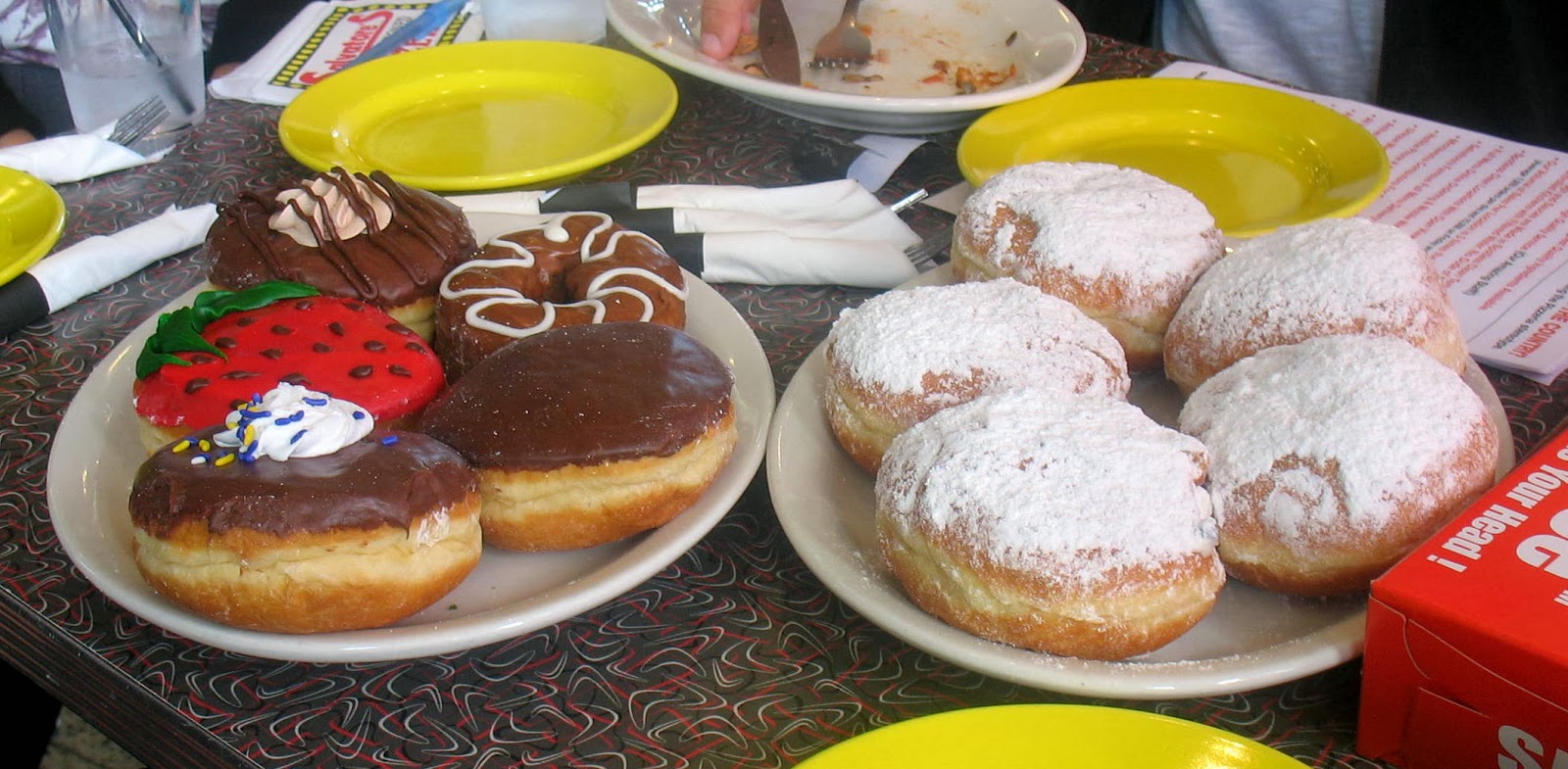
Since we were at the Donuts Delite location, we also talked a bit about doughnuts (somebody, I can't remember who, once wrote that they loved Donuts Delite for misspelling both words in its name, and for whatever reason, that's always stuck with me). In some ways, doughnuts are more of a challenge than pizza, because of the number of steps involved:  making the dough, the rise, cutting, frying, and filling, all to turn out a product that sells for about a dollar each. Salvatore's doughnuts are big, visually appealing, and fresh. Sam noted a competing chain's reference to their "baked" doughnuts, which I had wondered about when I saw their ads; in fact, those doughnuts (like nearly all doughnuts that you will find at a retailer) are fried, and only "baked" to reheat them.
In line with Sam's bent for innovation, Salvatore's also offers cannoli doughnuts, which, as the name implies, are doughnuts stuffed with cannoli filling. They also do "cronuts," a croissant-doughnut hybrid that's one of the latest food trends.
Toward the end of my visit, I got a behind-the-scenes tour of Salvatore's kitchen area, which was spotless and well-organized. I also got an up-close look at Salvatore's air-deck ovens, which Sam mentioned more than once. (He also expressed some disdain for conveyor ovens, saying that they produce "microwave pizza.") The kitchen area was remarkably cool, so the heat from those ovens must be very efficiently dispersed; I guess that goes along with Sam's intent to get away from the "sweaty pizza guy" image.
One technical note:  Salvatore's pizzas are baked on trays, which is not uncommon for a pizzeria with heavy volume, like Salvatore's. On a customer's request, they will remove a pizza from the tray and finish baking it directly on the oven deck, once the crust firms up. I'd like to try that sometime, to see what difference it makes in the final product.
As we toured the premises, it was clear to me that Sam is no "undercover boss." Employees recognized him and greeted him. He's clearly a hands-on guy, and among Salvatore's employees, stories circulate about his attention to detail, like the time he tasted the glass cleaner that somebody was using to see if it was the good stuff (it wasn't).
At the same time, I didn't get the sense that Sam is a tyrant, or a control freak in the sense of trying to micromanage each location's operations. He does delegate, and he depends on a reliable team of employees to keep things running smoothly.
But the key word there is "reliable." Sam is quick to admit that he counts on his employees, but they'd better be good, and know what they're doing. Employees who "don't get it" are swiftly shown the door.
After a good hour and half of conversation, I took my leave of Sam, Nick, Chuck and Ashley. I came away with a few impressions. First, Sam is a pretty personable guy. Of course, I don't have to work for him, but I enjoyed talking with him.
He also seems like somebody who's carried on his business the right way. What I mean by that is, he's got some integrity. Early on, Sam developed personal relationships in the pizza business, and he's maintained some loyalty and trust with suppliers and other people he's worked with.
I also got the sense that he's not out to screw anybody, competitors or otherwise. I don't know what his competitors think of Sam, but he expressed admiration for several other pizzeria owners, and he told me that he's refrained from opening up new stores next door to existing pizzerias owned by individuals he considers friends.
Sam is also proud of his accomplishments, and justifiably so, but he is not shy about giving credit to others, especially his employees. More than once Sam expressed his belief that he sees himself and his staff as part of a team. When I asked Sam to name the biggest reason for success, he quickly responded that he's been able to surround himself with "great people who are dedicated and committed."
What also struck me is that, as I mentioned earlier, Sam is not one to rest on his laurels. In response to a question about whether national chains had made things harder for him, he said that in some ways, his business has gotten easier, because it's much easier for him to follow industry trends today. Just look at what the big guys are doing.
And Sam does keep up with trends, avidly. Sam is a sponge for ideas, who's always looking for ways to stay ahead of the game. He didn't use the term "fast casual," but that's one of the hotter trends in the restaurant business these days, and in line with that, several Salvatore's now offer beer and wine, and are transforming into casual restaurants rather than simply fast-food slice joints.
I also think Sam is a dedicated, hard-working owner. He's not just sitting back collecting a paycheck while his underlings do the work. I don't know if I'd call him a workaholic, but this is a guy who by his account starts his day around 3:30 every morning, on about five hours' sleep. Every morning he meets with his staff (at a more reasonable hour, I hope), and he's clearly got a passion for detail.
Although Sam's roots will always be in pizzamaking, he also struck me as, in some ways, more of a business man than a pizza guy as such. At one point, in fact, he said to me, "We're business people, we're not pizza people." I don't think he meant that he's not interested in pizza, but that he recognizes that he's in the pizza business. Sure, he wants Salvatore's pizza to be good, but not just because he loves pizza; he wants his pizza to be good because that's good for his business.
I'm not about to say that's a bad thing. The pizzeria graveyards are probably filled, metaphorically, with the remains of places started by people who were passionate about pizza, but didn't have a clue about how to run a business. That's not Sam.
Sam's vision for Salvatore's, from the start, I think, has been to produce good, reliable pizza in a welcoming environment, and to stay on top of industry trends. And judging from Salvatore's success, I'd say he's largely achieved that goal. Some 35 years after that high school home ec project, Salvatore's is closing in on its 30th location, and Sam told me that he thinks the region can support more.
I'll be out there to try them and report on them. I liked the pizza we shared during this interview, but I'll keep checking up on Salvatore's, and Sam, I have to tell you, I won't hold back if I don't like it. But I don't think you'd want me to.
Now - Salvatore's has graciously agreed to give away, to one lucky reader of this blog, a $50 gift card.  You can get a lot of food for $50, pizza or otherwise. So this is a good one. And if you live in the Rochester area, there's almost certainly a Salvatore's near you.
How to qualify? Just leave a comment here (NOT after the blog post that you're reading now.) Sorry for any confusion, but I should have separated the giveaway from the interview from the beginning.
I'll pick a winner at random eight days from today, Tuesday, October 15, around noon. If you win, I'll need your postal mailing address, and Salvatore's will mail the gift card to you. So I will need some contact information to allow me to pass on your mailing address to them. You can do that now or wait until the contest ends.
Salvatore's (multiple locations; order online here)