Rochester NY Pizza Blog Rochester restaurants LocalEats featured blog

Tuesday, October 2, 2012

Fiamma, Buffalo Road

This past summer, I decided to take a drive over to General Hoock's on Buffalo Road, a pizzeria I hadn't been to for a while, just for an update. I was disappointed to see that it was closed, but my disappointment was partially mitigated by the sign in the window advertising a wood-fired pizzeria opening in that space soon.
I've been to enough wood-fired pizzerias by now to know that the presence of a wood-burning oven is no guarantee of great pizza, so while I was interested, I wasn't overly excited about the news.
A couple of weeks ago, I drove by again, and noticed that the restaurant had opened, under the name Fiamma. I arranged to meet some friends there for lunch.
The pizza portion of the menu was broken down into two categories: Le Pizze Tradizionali, and Le Pizze Specialita, each of which had a Margherita on it. On the traditional side was a $12 Margherita with tomato sauce, mozzarella, fresh basil, extra virgin olive oil, and Gran Cru cheese. The specialty Margherita, at $16, came with San Marzano tomato sauce, imported buffalo milk mozzarella, cherry tomatoes, oregano, basil, Gran Cru cheese, and extra virgin olive oil.
As I understood the menu, all of Fiamma's pizzas are made with San Marzano tomatoes, and though I was tempted to spring for the specialty version, I ended up going for the regular, "traditional" Margherita. Both my friends ordered a Diavola, which comes with tomato sauce, mozzarella, soppressata, basil, and spicy olive oil, also at $12.
Truth be told, I was a little taken aback by the prices. I know you can pay $5 for a single slice in New York City, but Fiamma's prices seemed a tad high for this area, especially for a pizzeria in a small strip plaza on a relatively nondescript stretch of Buffalo Road in Gates. Still, I tried to keep an open mind, and hope for the best.
Or at least I thought I was hoping for the best. What I got was better than what I had hoped for, and by the time I was done, the prices seemed eminently reasonable.
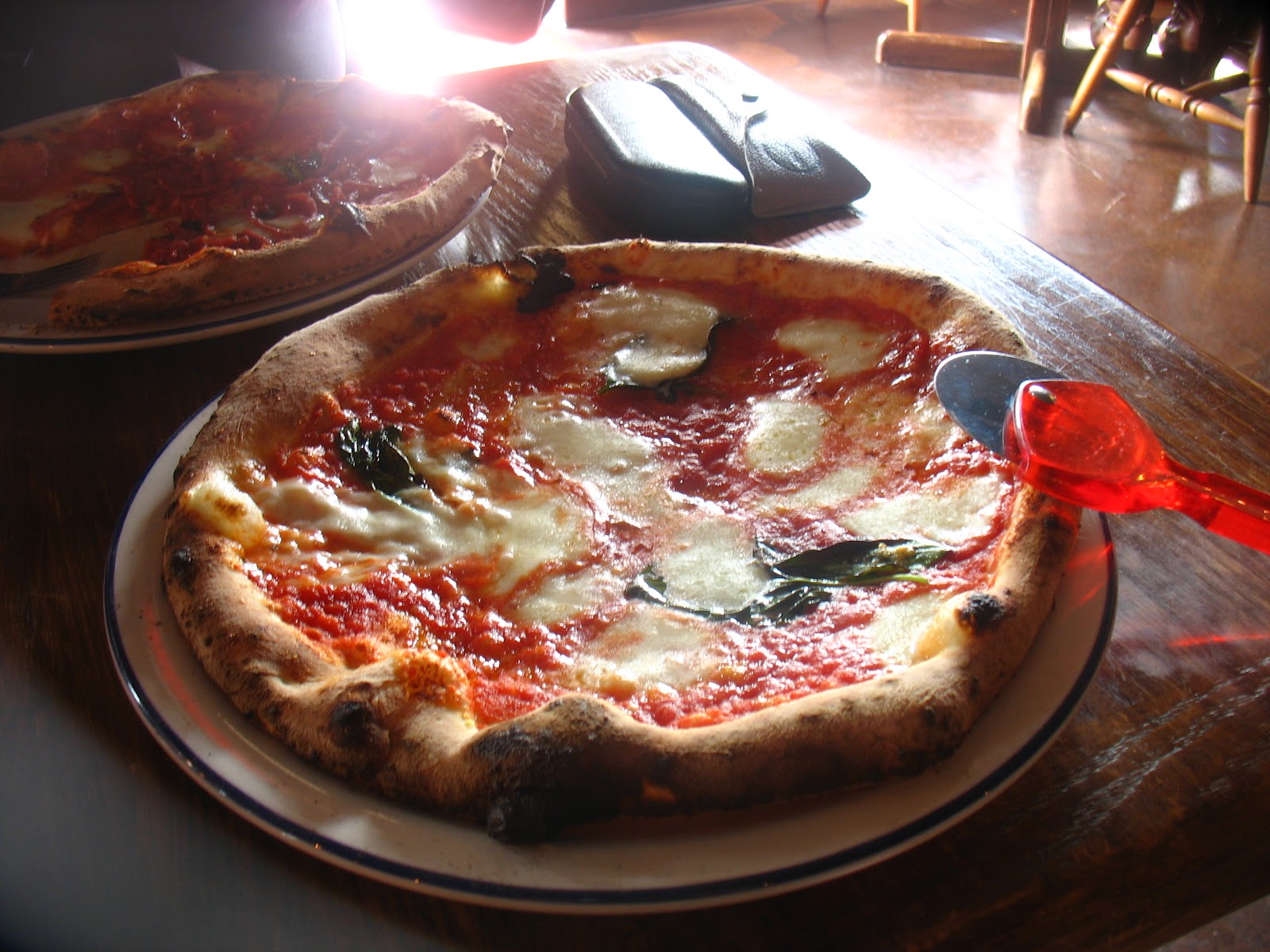
On arrival, the pie looked like a pretty good, if typical, wood-fired Margherita. But the closer I looked, the more intrigued I became.
First, there was the charring. I've had wood-fired pies that have a nice charred edge, but a pale underside. It's almost as if the charring is just there for show. And then there are some that are, quite frankly, burnt. There is a difference between charred and burnt, and to be sure, some customers aren't aware of that distinction, complaining that their pizza is burnt when in fact it's simply charred, on the surface. But some pizzaioli don't always seem to know the difference, either, serving up burnt pies and explaining that they're "supposed" to look that way.
This pizza showed the difference. It was lightly charred along the edge, and speckled with char spots underneath, across its bottom surface. In other words, it wasn't just blackened around the perimeter, by being exposed to the open flame for a few seconds - it was charred (not burnt) from the flame, yes, but also from coming into direct contact with a very hot oven floor. The edge was thick, but not heavy or dense, with crisp bubbles of charred dough encasing a series of small air pockets.
Despite the charring of the crust, the toppings didn't appear to be overdone at all. The fresh mozzarella had melted beautifully into the sauce, and the basil was wilted but still retained some of its vibrant green color.
What really struck me most, though, visually, was not the charring. On lifting up one side of my pizza (pizzas here arrive at the table unsliced, as in Italy), I found that the crust was actually translucent. If you've made bread or pizza, you probably are familiar with the "windowpane" test, which involves stretching a small piece of dough in your fingers. If you can stretch the dough thin enough for light to pass through it without the dough tearing, the gluten has been adequately developed. If it tears, keep kneading. This entire pie had been stretched to that point,with no holes or tears.
But the proof of the pizza is in the eating. If the crust were overly dry, or floppy, or flavorless, then its translucence would be no more than an impressive, but purely technical achievement. I mean, I can stretch Silly Putty until it's paper-thin, too, but I wouldn't want to eat it.
Happily, this pizza delivered on that score as well. For all its thinness, the crust was neither dried out nor limp, retaining enough structural integrity to bear the weight of the toppings, yet supple enough to fold without cracking.
As for the flavor - even before it reached my mouth, this pizza greeted my nostrils with its aroma, an enticing blend of toasty crust, tomatoes and basil. Those flavors - as felicitous a trinity as any in gastronomy - carried through on the palate. The sauce was rich, with a hint of sweetness from the tomatoes, and judiciously applied, as were the smooth, creamy slices of fresh mozzarella and the torn leaves of basil.
I did sample one of my companions' Diavola pies, which was also outstanding, broadly similar to the Margherita but with a peppery kick and the added textural dimension of thinly sliced soppressata. But I was more than happy with the subtle simplicity of my Margherita.
Particularly on a first visit, I rarely identify myself as a pizza blogger, and to the extent possible, I try to be subtle about taking notes and photos. I'm not looking for special treatment. But I had to meet the person responsible for this pizza.
That would be 32-year-old Giuseppe Paciullo, a native of Salerno, Italy, who learned his craft as a youngster before bringing his skills to New York City, where he spent the last few years before moving here. He told me that his girlfriend, who's from Rochester, convinced him to come here and open his own pizzeria, and all I can say is, thank you, girlfriend.
Talk with Giuseppe for a few minutes and you'll realize how devoted he is to pizza. With the exception of the fresh basil, all his ingredients are imported from Italy. I'm all for buying American, but this tells me that Giuseppe knows his ingredients, knows what he needs to make the pizza he has in mind, and will settle for nothing less.
Fiamma's oven burns a blend of hardwoods, which is the only heat source. And what a heat source. Giuseppe told me that the oven temperature generally reaches about 1000 degrees.
I used to think that stuff about extremely high oven temperatures was just so much hype, but I can't argue with the results here. As I spoke with Giuseppe, I watched as he put two pies in the oven, turning them every few seconds, and then took them out after what couldn't have been more than two minutes, perfectly done.
(That heat, I'm sure, is directly related to the thinness of the crusts. A thick crust would either come out with an underdone interior or a burnt exterior. But these? Perfect.)
Fiamma is a small place, with just a few tables and a small bar, which is awaiting its liquor license (although they appeared to have wine). Unless I'm way off the mark, you may soon find it packed on many nights, so I'd get there ASAP. They don't deliver, either - this is not the kind of pizza that you want to spend 30 minutes in a box before it gets to you. Only sheer willpower kept me from devouring my entire pie at lunch, and although it seems a crime to put this into a styrofoam container, I wanted my wife and daughter to be able to try it, even under less than ideal conditions (we'll all go there as a family soon, I assure you).
I've never been to Italy *sigh* but my gut tells me that this is as close as I've come, pizzawise. Forgive me if I've strayed into hyperbole here at times, but this was some of the best pizza I've had, period. It was right in so many ways, from the charring to the light, crisp, supple texture of the crust to the blend of flavors of the toppings ... well, I've think I've said all that I can. The next step is for you to go there and try it for yourself. Do I guarantee you'll like it as much as I did? No, and I never would. People's tastes can differ. But if your taste in pizza is anywhere close to mine, and I'm thinking it probably is if you're reading this blog, do yourself a favor and try Fiamma. It's a great example of the pizzamaker's art.
Fiamma, 1308 Buffalo Road, Gates
585-270-4683
email: info@fiammarochester.com
Lunch Mon. - Fri. 11:30 - 2:30
Dinner Mon. - Sat. 4:30 - 10:00
Sunday for private parties only

Friday, September 28, 2012

Ask the PIzzaiolo: How Much Difference Does the Pizzaiolo Make?

Ever order the same pizza from the same pizzeria on two different occasions, and one's good, and the other sucks? A lot of us have, and we've wondered, why? Same ingredients, same oven, same place - how can the pizzas come out so much different?
I recently got an email from a reader asking my opinion about why that phenomenon occurs. Specifically, he noticed that on certain days of the week (typically the days the shop owner was there) the pizza was very good. On other days, the crust was gummy, oily ... not good.
So how and why did that happen? How could one person make such a noticeable difference?
I had some theories, but in all honesty I had to admit that it would be better to turn to an expert - somebody who makes pizza for a living.
So I've asked a couple of local pizzaioli that basic question - how much difference does the individual pizzaiolo make? As long as you're working with the same basic setup, procedure, and ingredients, is the human element really that important in making pizza?
"Of course." That was the answer I got from Joe Staffieri of Joe's Brooklyn Pizza, who started out making pizza in his shop's namesake borough decades ago. Making pizza, he said, "is an art form," and can't be reduced to a simple formula. There are many nuances to making a good pizza, though few customers will ever be aware of them - unless they're done badly. This is my analogy, but think of it like an NFL game - if the refs do their job right, you don't notice the officiating at all. It's only when they get it wrong that they get noticed.
So what are some of those subtle elements that make the difference between a good and a bad pizza? Well, as Joe explained, there's a direct proportion between the freshness of the ingredients and the degree of skill required to turn them into a good pie. The reason is simple - the more you start from scratch, the more opportunities there are to get something wrong along the way. Anybody who's wondered why their spaghetti sauce or chicken soup never tastes as good as their mom's or their grandma's will know what I mean.
The specific ways to screw up a pizza are almost too numerous to mention. Every step of the process has its pitfalls. Was the sauce overcooked? Is it watery? Did it burn? Did the dough rise enough, or too much? Was it properly stretched to a uniform thickness? Were the toppings applied in the right proportions? How carefully was the pizza monitored once it went in the oven? Was it turned while baking, to avoid uneven cooking from hot spots in the oven?
Some of those same issues were mentioned, with a slightly different twist, by Tony Proietti of 2 Ton Tony's. Tony, who comes from a long line of Rochester pizzamakers, described making pizza - pizza dough, in particular - not as an art form but as a "science experiment." It's easy to understand why, as pizza dough, like most bread dough, includes yeast, a living organism. Yeast may be a relatively simply life form, but its workings can be mysterious and not entirely predictable. Any given batch of dough is subject to many factors, including the potency of the yeast, the ambient temperature and humidity, the length of the rise, and the way in which it's physically handled.
Tony also suggested that there may be a subconscious element at work as well, on the part of the customer. It's entirely possible that a customer may have a certain comfort level when he or she sees the owner behind the counter that's missing when it's a young employee making the pizza. Maybe the customer tends to cut the owner a little more slack, and scrutinizes the novice's pizza more closely. To go back to my NFL analogy, this season's replacement refs may have made more than their share of bad calls, but they were undoubtedly put under more of a microscope than the regular refs.
That said, Tony did acknowledge that the presence of an owner can make a noticeable difference in the final product. With more of a personal, emotional and financial stake in the business, an owner will typically tend to take more care in making a pizza, and to be more aware of and sensitive to the little things that can make a difference in the final product. An employee may look at pizzamaking as just a job, not a craft to which he or she is dedicated.
So does all that mean that you should only order a pizza when the owner is on the premises? Well, it's not quite that simple. Sure, if the owner is around, that's probably a good thing - like going to a restaurant on the night when the head chef is on duty - but the converse is not necessarily true. If you find that the pizza from your local pizzeria is consistently subpar on certain days, then try somewhere else on those days (and speak to the owner about it!). But it's certainly possible to get good pizza made by ordinary employees.
The key is good training, and a dedicated staff. Joe expressed some disdain for pizzerias that overly rely on inexperienced employees with minimal training, and he stressed that he's personally trained his entire staff, who clearly know what they're doing, and do it well. Tony expressed a similar sentiment when he told me, "Come work here for a week and you'll see" how much goes into making good pizza. "You have to have good people that you've trained and worked with."
Some places try to avoid the whole issue by taking skill out of the equation entirely, going with premade crusts, premeasured ingredients and conveyor ovens that require little or no human intervention until the pie is done. I'm not saying you can't produce a good pizza that way, but the best pizzas I've had have come from places where the pizzaiolo has more hands-on control over the entire process, start to finish.
Finally, even an accomplished pizzaiolo will make mistakes from time to time, and a good one knows when to start over. No good pizzeria should let a substandard pie go out the door.
In short, there's no substitute for - no shortcuts around - good training and experience, and for care and attention to detail. Pizzamaking is part art, part science, and for the best pizzaioli, it's a lifelong learning process. When I asked Joe Staffieri how long it takes to master the craft, his answer was, "I've been doing this since I was 13 and I don't know if I've mastered it yet."

Tuesday, September 25, 2012

Another Slice of Dragonfly

Dragonfly Tavern on Urbanspoon
I was recently on Park Avenue around lunchtime so I stopped in for a slice at Dragonfly, which I hadn't been to, or reviewed, in quite some time. In fact, my most recent review was in December 2009. 
I was disappointed that time, and I was hoping for better this time around.
Before I get to my slice, one change I noticed on the menu was that the range of specialty pies available had shrunk considerably. Dragonfly used to offer twenty-four specialty pizzas, from a hot "pepper pie" to a clams casino pizza, and even a fruit pie. But according to the menu I picked up on my visit, they're down to twelve, which is still a lot, but the aforementioned pies are no longer available. Maybe it got too expensive to keep the ingredients on hand for pies that weren't selling, so they pared down the men a bit. But you can still get a mac 'n' cheese pie, which you will certainly not find at most other pizzerias around here.
If you only want a slice, your options are much more limited, which is understandable, since you don't want to keep a sliced specialty pie sitting there for hours. Better to offer fewer but fresher slices.
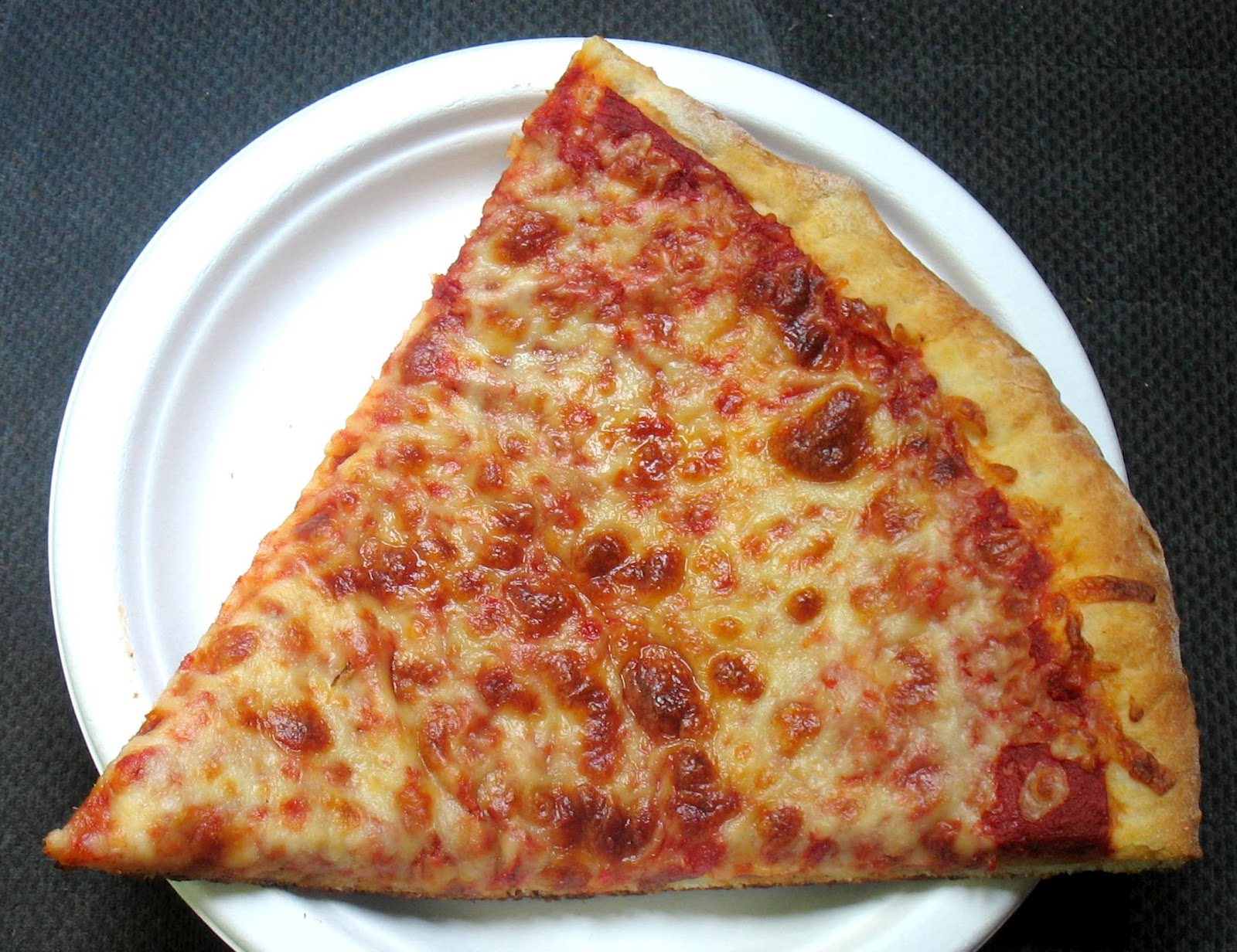
I got a cheese slice. It was, well, OK.
The underside of the thin-to-medium crust was well browned, very well browned, in fact, but not crisp. It was also heavily screen-marked. On the plus side, there was some toasty flavor, but it was mixed with a faint aroma of oil. The underside wasn't greasy, except for along the cut edges where some oil had seeped down from above, having exuded from the cheese, I guess.
Topside, a layer of basic tomato sauce lay underneath a blanket of browned mozzarella. The flavor was fine, but nothing exceptional. The outer edge was golden brown on top and dark brown and crunchy underneath.
All in all, this was an OK slice of pizza, but nothing special. It was very much an average slice for around here, with standard, melted/browned mozzarella and red sauce atop a crust that was not greasy (good) but not crisp (not so good). And for as dark as it was underneath, that browning didn't translate into a great texture or a lot of flavor. So not bad, good enough for a quick pizza fix, but just average. It gets a C.
Dragonfly Tavern & Pizza Factory, 725 Park Ave.
585-563-6333
Open 11:00 a.m. – 2:00 a.m. daily, limited menu after midnight.
$10.00 minimum on deliveries + $1.00 delivery charge